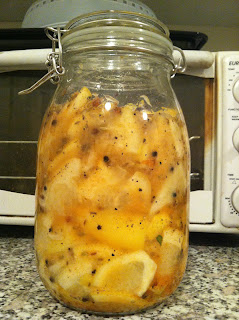
These Moroccan Preserved Lemons are delicious! They really add a new layer to Moroccan cooking, and are great to add to salads and other dishes. They have a very unique flavor and a silky smooth texture that really cannot be beat.
I have always had an illicit love affair with lemon pickles. When I was growing up, one of my favorite dishes was South Indian Red Lemon Pickle with rice. That's it. Just rice and red lemon pickle. I could eat that everyday! As a kid, all the lemon pickle I has was flavored with chili powder, making it very tasty, but also very red. In our house, red pickles were the pickles du jour: red mango pickle, red lemon pickle, red gooseberry pickle....the list goes on and on. Fiery hot and spicy, these pickles really punch up the spice factor on any dish.
When I was working in South India, I visited my aunt and uncle. They make their own pickles, and I was powerfully impressed! They have this
white lemon pickle that was out of this world. Obviously, freshly made home pickles will always beat anything store bought. Hands down. But these were especially good! Tart, tangy, slightly salty, slightly spicy, it is one of the rarest forms of pure pleasure in this world. My aunt gave me one fairly large bottle of lemons, which I had judiciously used over the past several years (yes they can last that long!).
My supply of lemon pickle was running low, and I was getting desperate. I would anxiously comb Indian stores in Berkeley, Fremont, Pleasanton...anywhere there was a reasonably large contingency of Indians, I figured somewhere there would be a store that sold White Lemon Pickle.
Alas, there was none. Returning home empty handed on several occasions, my hopes all but dashed....Enter.....
The Pop Up Grocery Store????
Robyn and I participated in a "Pop Up" grocery store here in Oakland. A variety of local food merchants would gather at a predetermined location, set up shop ("pop up") and sell their wares. We got a small bottle of Moroccan preserved lemons made by a company called
Studebaker Pickles. I had the pleasure of meeting the owner at
the Eat Real Festival in Oakland this past weekend. Perhaps the company is in reference to drying out goods in an old Studebaker? Anyways, their Moroccan pickles are amazing! It wasn't the same flavor profile as South Indian white lemon pickles, but they were delicious in their own right!
This was the closest thing I could find to my aunt's South Indian White Lemon Pickle. I figured it was a poor substitute, but it would have to do.
I was pleasantly surprised by the flavor! They are absolutely delicious! Made with star anise, bay leaves and red chilies, it was tart and tangy, with a pleasant spiciness. Looks like I found a new addiction!
I gobbled it all up and used it for most of my South Indian dishes. It gave the dishes a slightly different flavor profile, which was..shall we say "interesting"? It really shone when I was making some North African dishes, which I think is most appropriate! Preserved Lemons are really indispensable to Moroccan cooking. They had such flavor and dimension to a dish.
My supply was running low, and I was quickly becoming a lemon pickle addict. I needed a new resource, but couldn't find any anywhere....Fortunately, one of Robyn's coworkers has a lemon tree and one day Robyn came home with an entire grocery bag of lemons! These were huge lemons, they did not have much juice to them, but they were really big. What a boon!
If life give you lemons, make....Moroccan Preserved Lemons?? Yes!
Desperation forced me to look elsewhere. I scoured the internet for a recipe for Moroccan Preserved Lemons. I talked with my cousin (my aunt's daughter) to get my aunt's recipe for White Lemon Pickle and compare it to recipes I was finding for Moroccan Preserved Lemons.
This recipe comes from
Paula Wolfert's book Couscous and Other Good Food from Morocco, which I found this recipe on Epicurious. Its really quite good. The hardest part about making these lemons is having patience not to eat them before they are cured. You also will need lots of lemons. The ones I got from Robyn's coworkers were huge! I had never seen lemons that big. They didn't have much juice in them. Researching this recipe, I discovered that Moroccan lemons are smaller and much juicer than their American cousins. I think Meyer lemons would work great in this recipe, but I had big lemons.
The key to this recipe is to be certain that the lemons are completed submerged in the salted lemon juice. Sometimes, you will see some sort of white substance on the lemons. Its perfectly harmless and natural. You can wash it off if you want to, but eating the lemon that way is fine.
Once you make enough of these, keep a jar of the used pickling liquid around. When you are making other dishes that require lemons, wash the lemons and use the lemon as required by the recipe. Take any remainder of the lemon, cut it up and add it to used pickling liquid.
When removing the lemons from the jar, use wooden chopsticks or a wooden spoon.
The whole idea behind pickling is so you don't have to refrigerate the pickles when they are done. I keep mine in the fridge, simply because I don't have enough counter space to keep them on my kitchen counter!
Ingredients
5 lemons (preferably Meyer)
1/4 cup salt
Pickling Spice Mixture
1 cinnamon stick
Cloves
Coriander seeds
Roasted black peppercorns
Fennel Seeds
3 Star Anise
2 bay leaf
Smoked Spanish Paprika
Freshly squeezed lemon juice
Special Equipment
1 sterilized large Sealed Glass Jar (dishwasher safe)
Tongs
1 cookie tray with cookie cooking rack
1 large pestle
Meyer lemons really make this dish! I used lemons from a friend's tree, I don't know the variety. They were rather hard, so I needed to use more salt, and really smash them down with a pestle.
Procedure
Sterilize your jar. This is important, because you don't want any bacteria inside the jar eating away at your lemons! You want a glass jar (not plastic) and you want it to be dishwasher safe. A large pickling jar is best.
Take a large stockpot and add some water to it. Bring it to a boil, reduce heat and place your pickling jar upside down in the pot. Place the top on the stockpot and steam for 10 minutes.
Wrap rubber bands around the ends of a pair of thongs (for a better grip) and place on a clean cloth dish towel upside down.
.JPG)
Quarter the lemons. I cut the lemons in half lengthwise, and then cut each of those halves into 4 quarters.
.JPG)
Place a cookie cooling rack on top of a a cookie sheet. Place the lemons on the cooling rack. Generously sprinkle salt over all the lemons, and let sit uncovered for at least overnight, but ideally for 24 hours. You will see some of the lemon juice has drained out of the lemons and collected in the cookie sheet.
Make your spice mixture. I dry roasted coriander seeds, black peppercorns and the fennel seeds and let them cool in a bowl. I then added cloves, star anise and bay leaves to the bowl.
.JPG)
The next day, set up your lemon station. Place the cookie sheet with the lemons and thongs on the left side of the counter. Next to the lemons have a small bowl with your pickling spices and a spoon. Place the pickling jar next to the spices. Have your paprika handy there. On the far right, place a large pestle for pressing down the lemons on top of a clean cloth or paper towels.
Place a tablespoon of salt at the bottom of the glass jar. With the tongs, add 3 or 4 lemons to the jar. Add a sprinkle of salt and some of the additional spices and paprika. With a large pestle, smash the lemons down (they should be fairly soft already from the salting of the previous night). You can be fairly abrasive here. The lemons I used had a fairly tough skin (even after bathing them in salt overnight). So press hard. Its okay if the lemon breaks into pieces or cracks a bit. By pressing the salt and other spices into the lemon flesh, it will help break it down.
.JPG)
Once you have the bottom layer of the jar filled with lemons, take 1 cinnamon stick and press it into some of the lemon peel. Can you see the cinnamon stick in the picture? It is almost fully buried by the lemons!
Continue to add the cut lemons to the jar with the thongs, following the same order: lemons, salt, spices, paprika until the cinnamon stick is fully covered by at least one layer of lemons.
.JPG)
Once the cinnamon stick is fully covered by a layer of lemons, continue to add more of the lemons to the jar, following the same order: lemons, salt, spices, paprika. However, from here on out, after you add a layer of spices, press the lemons down with the pestle (you don't want to do that earlier because the cinnamon stick would get in the way). Just repeat it like a mantra: lemon, salt, spices, paprika, press. Lemons, salt, spices, paprika, press.
Continue to add more lemons to the jar, until it reaches the top. You will want to have a good 2 inches of space at the top of the jar. This is for 2 reasons. First, the salt is going to start reacting to the lemons, drawing out the juices of the lemons. As it does this, the liquid level will start to rise in the jar.
Second, as you continue to use lemons for different recipes, you can add the skins to the jar instead of throwing them away. Awesome!!! As you can see, as I used lemons for different recipes, I added the rinds to the jar, filling it to the top. This was a mistake--you really need to have some space at the top, because those lemons will bleed juice.
The next step is the hardest. Let the lemons just sit and stew in their juices for the next 30 days. I put a PostIT note on my jar for the day I pickled it. You want to place the pickles in a warm place with lots of sun (Morocco is a warm place after all!). You can flip the jar upside down once a day to distribute the spices. I didn't, because my jar had a slight leak in it! You will notice that the lemons start to bubble up, creating a foamy liquid froth. Don't worry, its all part of the process.
After 30 agonizing days, you are set to eat your lemons!
You don't need to refrigerate these lemons, as the salt preserves them. Just always be sure that the lemons are completely submerged in the salty liquid.
Since I had a whole jar, I started in on a new jar. This time, I am just using a smaller tomato sauce jar. I added alot of salt, and some of the spices (cloves, coriander seeds, fennel seeds) to the mix. They are beginning to smell wonderful! Every time I juice a lemon, and I have the rind left over, I add it to this jar, which is just sitting out on my kitchen table. We shall see what happens to them...
Enjoy!!!


.JPG)
.JPG)
.JPG)
.JPG)
.JPG)


